If you love the idea of living in Sugar House but worry about the monthly payment, house hacking may be the strategy that makes the numbers feel more realistic. For many buyers, the appeal is simple: live in one part of the property and use a legal second unit to help offset your mortgage and other carrying costs. In a neighborhood with older homes, mixed housing types, and strong transit access, Sugar House gives you several angles to explore. Let’s dive in.
Why house hacking works in Sugar House
Sugar House stands out because it is not a one-note neighborhood. According to the Sugar House master plan, the area includes older bungalow-style streets, medium-density housing, townhouses, garden apartments, mixed-use and live-work housing, and some areas with up to four-plex-style development patterns.
That matters because house hacking works best in places where the housing stock already offers variety. In Sugar House, you may find opportunities in homes with basement layouts, properties with room for an ADU, or small multifamily properties where owner occupancy is part of the plan.
The neighborhood is also largely built out, which creates a different dynamic than newer suburban areas. Instead of counting on brand-new inventory, you are often evaluating older homes, infill opportunities, and properties with unique permit histories. That can create opportunity, but it also makes due diligence especially important.
What house hacking means here
In Sugar House, house hacking usually means buying an owner-occupied property and using a legal basement suite, ADU, or second unit to generate long-term rental income. The goal is not to turn the home into a short-term rental operation. Under Salt Lake City code, an ADU and the principal structure cannot be used for short-term rental.
That makes this strategy a better fit if you want steady, longer-term income to help with monthly housing costs. It can be especially appealing for first-time buyers who want to enter the market without taking on the full payment burden alone.
Best property types to watch
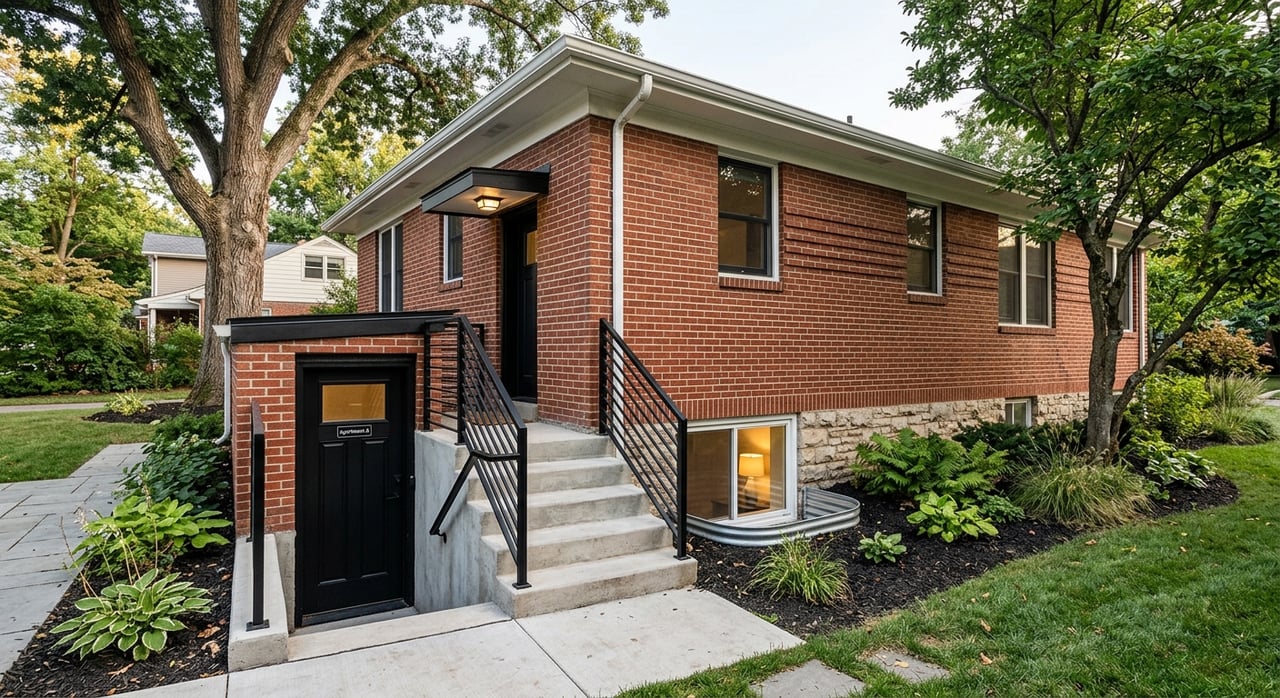
Basement homes with internal ADU potential
Older Sugar House homes often make basement conversions one of the most practical house hacking paths. Salt Lake City allows a single ADU on a property where permitted, requires a building permit, requires a zoning certificate before occupancy, and does not set a minimum lot size for an ADU.
One detail makes internal ADUs especially interesting: city code says internal ADUs have no maximum gross floor area. In a neighborhood known for older homes with basements, that can make interior conversions more flexible than many buyers expect.
Homes with room for a detached ADU
A detached backyard cottage can also work, but it usually comes with more physical constraints. Salt Lake City caps detached ADUs at 1,000 square feet, and they are more affected by lot size, setbacks, lot coverage, height limits, and parking requirements.
In practical terms, lot depth and backyard layout matter a lot. A property may look promising online, but the parcel details can quickly determine whether a detached ADU is realistic.
Duplexes and small multifamily homes
If your budget and financing line up, duplexes and other 2- to 4-unit properties are classic house hack options. You live in one unit and rent the others, which can create a more direct path to offsetting the mortgage.
This property type can also offer financing advantages. Freddie Mac states that for 2- to 4-unit owner-occupied primary residences, rental income from the other units can be added to the borrower’s income, and FHA financing is available for 1- to 4-unit properties.
Financing rules that shape your options
FHA can open the door
FHA loans can be used on 1- to 4-unit properties and allow down payments as low as 3.5 percent. FHA also generally allows lower credit scores than conventional financing, although mortgage insurance is required.
For a buyer trying to enter Sugar House with a limited down payment, that can be meaningful. It does not make every property affordable, but it can expand the pool of homes you can seriously consider.
Conventional financing may count some rental income
For owner-occupied 2- to 4-unit properties, Freddie Mac allows rental income from the other units to count toward borrower income. Its published guidance notes a 620 minimum Indicator Score and a 45 percent maximum debt-to-income ratio for manually underwritten loans.
Fannie Mae also allows some rental income treatment, but the rules differ by property type. For a one-unit principal residence with an existing ADU, only one ADU’s income can be counted, and the qualifying amount is capped at 30 percent of total qualifying income.
The deal still has to work in real life
Lenders must make a good-faith determination that you can repay the loan based on factors like income, assets, employment, credit history, and monthly expenses. In plain English, that means your plan should have some margin for error.
If the projected rent comes in lower than expected, or the unit sits vacant for a stretch, you still want the payment to feel manageable. A strong house hack is not just one that gets approved on paper. It is one that still feels sustainable after closing.
Local rules to understand before you buy
Owner occupancy matters on many single-family setups
Salt Lake City requires owner occupancy for ADUs on single-family dwellings. That is a key point if your plan is to buy a single-family home with an attached or internal ADU and use it as a house hack.
The rules shift on some other property types. City code says owner occupancy is not required for an ADU on a property whose principal use is a duplex, multifamily dwelling, or non-residential land use.
Short-term rental plans do not fit this strategy
If you are picturing Airbnb-style income, Sugar House house hacking may not match that plan. Salt Lake City requires a recorded restrictive covenant for ADUs, and that covenant must state that the ADU and principal structure cannot be used for short-term rental.
That pushes most buyers toward a long-term rental model. For many owner-occupants, that is actually a better fit because it tends to be more stable and easier to underwrite.
Historic district details can affect the process
Some properties may also need extra review. Salt Lake City’s guide notes that homes in historic districts may require a Certificate of Appropriateness.
That does not automatically rule out a property, but it can affect your timeline, renovation scope, and overall budget. If you are comparing two homes, this is one of those details that can make one path much smoother than the other.
Why transit can make some properties stronger
Transit access is part of the Sugar House story. UTA’s S-Line serves Sugar House, connects to TRAX and the Parley’s Trail greenway, and Salt Lake City is extending the S-Line toward the shopping district with service anticipated in late 2027.
That matters for more than convenience. Salt Lake City code provides an ADU parking waiver when a property is within one-quarter mile of a transit stop or within one-half mile of a city-designated bike lane or path.
For certain parcels, that can remove one of the trickier hurdles in ADU planning. In a built-out neighborhood where parking and layout can be limiting factors, that kind of location detail can make a big difference.
Sugar House due diligence checklist
Before you assume a property is a great house hack candidate, slow down and verify the details at the parcel level. Sugar House includes a mix of land-use patterns and older homes, so two properties on nearby blocks can have very different possibilities.
Here are the core items to review:
- Confirm the current zoning for the specific parcel
- Verify whether there is a historic overlay or district review requirement
- Check whether the existing second unit or basement apartment has legal permit history
- Review parking feasibility and whether a parking waiver may apply
- Confirm whether the property setup fits Salt Lake City’s owner-occupancy rules
- Make sure your plan is based on long-term rental income, not short-term rental use
Permit history deserves extra attention in Sugar House. The neighborhood plan notes that older areas have seen legacy multi-unit conversions over time, so you do not want to assume an existing basement apartment is legal just because it has been there for years.
A smart way to evaluate the numbers
House hacking is most useful when you treat it like both a home and a financial decision. Start with the full monthly carrying cost, including principal, interest, taxes, insurance, and any expected utility or maintenance differences tied to the second unit.
Then compare that total against realistic long-term rent expectations for the unit type you are buying. The goal is not to stretch to the maximum number a lender might allow. The goal is to buy something that still fits your life if repairs come up or rent fluctuates.
For many buyers in Sugar House, the sweet spot is not the most ambitious project. It is the property where the layout, permit path, financing, and long-term livability all line up with fewer surprises.
Why local guidance matters in Sugar House
Sugar House can reward buyers who know how to read the details. A charming older home with a basement apartment may look perfect at first glance, but the real value depends on zoning, permit history, occupancy rules, parking, and financing fit.
That is where local, neighborhood-level guidance can save you time and stress. When you are comparing one block, one parcel, and one layout against another, local knowledge matters just as much as the list price.
If you are thinking about buying in Sugar House and want to explore whether house hacking could work for your budget and goals, Nick Booth Real Estate can help you evaluate the right property, ask the right questions, and move forward with clarity.
FAQs
What does house hacking in Sugar House usually look like?
- In Sugar House, house hacking usually means buying an owner-occupied home and using a legal basement suite, ADU, or another unit on the property to generate long-term rental income that helps offset your housing costs.
Can you use an ADU for short-term rental income in Sugar House?
- No. Salt Lake City requires a recorded restrictive covenant for ADUs stating that the ADU and the principal structure cannot be used for short-term rental.
Can FHA financing work for a Sugar House house hack?
- Yes. FHA loans can be used on 1- to 4-unit properties and allow down payments as low as 3.5 percent, although mortgage insurance is required.
Can rental income help you qualify for a Sugar House house hack?
- In some cases, yes. Freddie Mac allows rental income from the other units to be added to borrower income for 2- to 4-unit owner-occupied primary residences, and Fannie Mae has separate rules for qualifying income from an existing ADU on a one-unit principal residence.
What should you verify before buying a Sugar House property for house hacking?
- You should verify zoning, any historic overlay, parking feasibility, owner-occupancy requirements, and legal permit history for any existing or planned second unit before assuming the property will work for your plan.